Walking Catfish

Clarias batrachus

Clariidae · freshwater and brackish water fish

8 minute read · Species guide

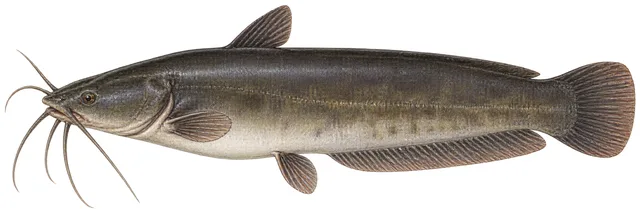
Walking Catfish field guide illustration

About Walking Catfish

The walking catfish (Clarias batrachus) is a species of freshwater airbreathing catfish native to Southeast Asia. It is named for its ability to "walk"and wiggle across dry land, to find food or suitable environments. While it does not truly walk as most bipeds or quadrupeds do, it can use its pectoral fins to keep it upright as it makes a wiggling motion with snakelike movements to traverse land. This fish normally lives in slow-moving and often stagnant waters in ponds, swamps, streams, and rivers, as well as in flooded rice paddies, or temporary pools that may dry up. When this happens, its"walking" skill allows the fish to move to other aquatic environments. Considerable taxonomic confusion surrounds this species, and it has frequently been confused with other close relatives. One main distinction between the walking catfish and the native North American ictalurid catfish with which it is sometimes confused, is that the walking catfish lacks an adipose fin. It can survive 18 hours out of water.

Characteristics and anatomy

The walking catfish has an elongated body shape and reaches almost 0.5 m (1.6 ft) in length and 1.2 kg (2.6 lb) in weight. Often covered laterally in small white spots, the body is mainly coloured a gray or grayish brown. This catfish has long-based dorsal and anal fins, as well as several pairs of sensory barbels. The skin is scaleless, but covered with mucus, which protects the fish when it is out of water.

This fish needs to be handled carefully when fishing it due to its embedded sting or thornlike defensive mechanism hidden behind its fins (including the middle ones before the tail fin, similar to the majority of all catfishes).

Taxonomy, distribution, and habitat

The walking catfish is a tropical species native to maritime Southeast Asia. The native range of true Clarias batrachus is confirmed only from the Indonesian island of Java, but three closely related and more widespread species frequently have often been confused with this species. These are C. magur of northeast India and Bangladesh, a likely undescribed species from Indochina, and another likely undescribed species from the Thai-Malay Peninsula, Sumatra, and Borneo. Both of these undescribed species have been referred to as, Clarias aff. batrachus. At present, the taxonomic position of the Philippines population (called hito or simply "catfish" by the locals) is unclear, and it also is unclear whether South Indian populations are C. magur or another species. As a consequence, much information (behavioral, ecological, related to introduced populations, etc.) listed for C. batrachus, may be for the closely related species that have been confused with true C. batrachus. True C. batrachus, C. magur and the two likely undescribed species are all kept in aquaculture.

Walking catfish thrive in stagnant, frequently hypoxic waters, and often are found in muddy ponds, canals, ditches, and similar habitats. The species spends most of its time on, or right above, the bottom, with occasional trips to the surface to gulp air.

Diet

In the wild, this creature is omnivorous; it feeds on smaller fish, molluscs, and other invertebrates, as well as detritus and aquatic weeds. It is a voracious eater that consumes food supplies rapidly, so it is considered harmful when invasive.

As an invasive species

Within Asia, this species has been introduced widely. It has also been introduced outside its native range where it is considered an invasive species. It consumes the food supplies of native fish and preys on their young. It also is regarded as an invasive species because they can destroy fish farms.

In the United States, it is established in Florida. It is reported in California, Connecticut, Georgia, Massachusetts, and Nevada. The walking catfish was imported to Florida, reportedly from Thailand, in the early 1960s for the aquaculture trade. The first introductions apparently occurred in the mid-1960s when adult fish imported as brood stock escaped, either from a fish farm in northeastern Broward County or from a truck transporting brood fish between Dade and Broward Counties. Additional introductions in Florida, supposedly purposeful releases, were made by fish farmers in the Tampa Bay area, Hillsborough County in late 1967 or early 1968, after the state banned the importation and possession of walking catfish.

Aquarium releases likely are responsible for introductions in other states. Dill and Cordone (1997) reported this species has been sold by tropical fish dealers in California for some time. They also have been spotted occasionally in the Midwest.

In Florida, walking catfish are known to have invaded aquaculture farms, entering ponds where they prey on agricultural fish stocks. In response, fish farmers have had to erect fences to protect ponds. Authorities have also created laws that ban possession of walking catfish.

In 2017, Clarias spp. were recovered from the River Tonge, in Bolton, England.

As food

In Indonesia, it is commonly referred to as lele, or when needing distinction; lele jawa or lele kampung, compared to lele dumbo or lele sangkuriang which refers to the introduced C. gariepinus. It is the main ingredient in several traditional dishes, such as pecel lele and mangut lele.

In Thailand, Clarias aff. batrachus is known as pla duk dan (Thai: ปลาดุกด้าน). It is a common, inexpensive food item, prepared in a variety of ways. It is often offered by street vendors, especially grilled or fried.

This fish is also one of the most common freshwater catfish in the Philippines, which as aforementioned is known as hito in the local language. Despite this, current evidence of Clarias aff. batrachus populations from other regions of southeast Asia and India in relation towards C. batrachus have not been thoroughly studied.

Aquarium

A white or calico color pattern is commonly seen in the aquarium fish trade. However, this color variation also is prohibited where walking catfish are banned. Very well-rooted plants and large structures that provide some shade should be included in an aquarium with these fish. Any small tankmates will be eaten by this fish.

Article text: Wikipedia contributors, Walking catfish (source revision). Licensed under CC BY-SA 4.0. Retrieved 2026-10-11.
Diet and feeding

The FishTraits compilation records these diet categories for this species: aquatic or other vascular plants; detritus or unidentified plant material; invertebrates or larval fish; larger animal prey (a source category covering fish, crayfish, crabs, or frogs); fish or frog eggs. These are broad categories, not a claim that every individual consumes every example in a category.

Reported feeding positions include bottom feeding. The compilation combines published observations; diets can vary with age, locality, and available food.

Habitat preferences

Reported habitat associations include medium to large rivers, still-water habitats.

The source records associations with muck, clay or silt, sand. An association indicates reported use, rather than an exclusive requirement.

The species is classified as tolerant of a broad range of salinities. This flag does not specify a salinity range for aquarium care.

Reproduction and parental care

The compilation reports a representative maturity age of 1 years. Its maturity field summarizes mean, median, or modal estimates, usually for females; male estimates can be used when female data are unavailable. It is not a fixed age at which every fish first breeds.

Recorded spawning months are May, Jun, Jul, Aug, Sep, Oct for the source’s reporting region (FL). This is a regional calendar, not a range-wide schedule.

The reproductive-guild classification includes guarding eggs or young at a spawning substrate or nest.

Size and recorded longevity

FishTraits reports a maximum total length of 47 centimetres. Some entries use an estimated asymptotic length; this value should not be treated as a certified record catch.

Recorded longevity in the compilation is 8 years. Wild observations were preferred, but captive records were accepted where wild records were unavailable, and unspecified records were assumed wild. The value is not a guaranteed wild lifespan or an aquarium life expectancy.

Identification and appearance

Page and Burr (1991). Keys and distinguishing characteristics were given by Smith (1945), Talwar and Jhingran (1992), and Kottelat et al. (1993). The identity of the fish introduced into the USA is in doubt following an analysis by Ng and Kottelat (2008), which restricted the name, C. batrachus, to fish from Java. A photograph appeared in Kottelat et al. (1993).

Native range

Southeastern Asia including eastern India, Sri Lanka, Bangladesh, Burma, Indonesia, Singapore, and Borneo (Lee et al. 1980 et seq.; Talwar and Jhingran 1992; Kottelat et al. 1993). Laos (Baird et al. 1999). Probably introduced into the Philippines.

Introduction history

The walking catfish was imported to Florida, reportedly from Thailand, in the early 1960s for the aquarium trade (Courtenay et al. 1986). The first introductions apparently occurred in the mid-1960s when adult fish imported as brood stock escaped, either from a fish farm in northeastern Broward County or from a truck transporting brood fish between Dade and Broward counties (Courtenay and Miley 1975; Courtenay 1979a; Courtenay and Hensley 1979a; Courtenay et al. 1986). Additional introductions in Florida, supposedly purposeful releases, were made by fish farmers in the Tampa Bay area, Hillsborough County in late 1967 or early 1968, after the state banned the importation and possession of walking catfish (Courtenay and Stauffer 1990). Aquarium releases likely are responsible for introductions in other states (Courtenay and Hensley 1979a; Courtenay and Stauffer 1990; Hartel 1992). Dill and Cordone (1997) reported that this species has been sold by tropical fish dealers in California for some time.

Ecological impacts

Summary of species impacts derived from literature review. Click on an icon to find out more... Largely unknown. In Florida, walking catfish are known to have invaded aquaculture farms, entering ponds where these predators prey on fish stocks. In response, fish farmers have had to erect protective fences to protect ponds (Courtenay and Stauffer 1990). Loftus (1988) reported heavy predation on native fishes in remnant pools during seasonal drying of wetlands. Baber and Babbitt (2003) examined predation impacts on tadpole assemblages in temporary wetlands in south-central Florida, and found that native fishes (e.g., eastern mosquitofish Gambusia holbrooki, golden topminnow Fundulus chrysotus, flagfish Jordanella floridae) had larger impacts and higher predation rates on tadpoles than C. batrachus.

Range

Where it lives

Share of 939 GBIF observation records with a state location, across 5 states.
0%
99.6%
Share of 939 GBIF observation records with a state location, across 5 states.

Habitat

Water and movement

Water
WoRMS records this species in fresh water and brackish water.
USGS NAS habitat
Freshwater
US status
Exotic — the USGS Nonindigenous Aquatic Species database lists it as introduced from outside North America.
Migration
Migratory
Pattern

Classification

Taxonomy

Kingdom
Animalia
Phylum
Chordata
Superclass
Actinopterygii
Class
Teleostei
Order
Siluriformes
Family
Clariidae
Genus
Clarias
Species
Clarias batrachus
ITIS TSN
164120
WoRMS AphiaID
280201
GBIF key
5202683
Outside the US
ITIS also files it in Central Pacific Territories.

Common questions about Walking Catfish

What is the scientific name of Walking Catfish?
The scientific name is Clarias batrachus, in the family Clariidae. Classification follows ITIS.
Does Walking Catfish live in fresh water or salt water?
WoRMS records this species in fresh water and brackish water.
Where has Walking Catfish been recorded in the United States?
GBIF has observations in 5 states, with the most records in Florida, Alabama, California. The map shows observation records, which do not establish the complete natural range.

Closest relatives

Other Clarias species

Same family

More Clariidae