Spotfin Spiny Eel

Macrognathus siamensis

Mastacembelidae · freshwater water fish

3 minute read · Species guide

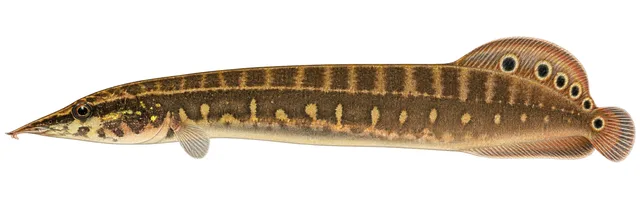
Spotfin Spiny Eel field guide illustration

About Spotfin Spiny Eel

Macrognathus siamensis, the peacock eel or spotfin spiny eel, is a spiny eel found in freshwater habitats throughout Southeast Asia. They are commercially important as food and aquarium fish.

Distribution

The peacock eel is native to the Mekong and Chao Phraya basins, which make up the countries of Thailand, Cambodia, Laos, and Vietnam. They are mostly found in slow-moving backwaters that have a sandy or muddy bottom, such as swamps, canals, and ponds.

There is an invasive population of peacock eels in the Everglades region of Florida, most likely being released due to the aquarium trade. The eels were first discovered in the C-111 canal in 2002, and in 2004 were also found to inhabit mangrove swamps further south.

Description

These fish lack scales and require a soft substrate to burrow into, such as sand, mud, or silt. They breed during the wet season when adjacent forests flood. Larvae reach 8 cm (3 in) in length in approximately 60 days after hatching.

This eel can grow up to 30 cm (12 in) in standard length, although 20 cm (8 in) is more common. Males and females are hard to tell apart through external means.

Additional field notes

The eye-like marks along the dorsal fin and dusk feeding behavior are useful features of the spotfin spiny eel.

Sources: Macrognathus siamensis species summary

Identification and feeding activity

FishBase describes three to six conspicuous eyespots along the base of the soft dorsal fin and 13–19 dorsal spines. It notes that the dorsal, anal, and tail fins remain separate. These features help narrow an identification among superficially similar spiny eels.

The fish often remains buried in fine bottom material with only part of the head showing, then emerges around dusk to feed. Reported prey include bottom-dwelling insect larvae, crustaceans, and worms. A hidden daytime fish and an actively foraging evening fish can therefore represent normal behavior at different times of day.

Sources: Macrognathus siamensis species summary

Guide sources

Research reviewed 2026-10-19.

Article text: Wikipedia contributors, Macrognathus siamensis (source revision). Licensed under CC BY-SA 4.0. Retrieved 2026-10-11.

Identification and appearance

Elongate, eel-like fish with a compressed tail and a row of small spines along the back anterior to a soft-rayed dorsal fin; pectoral and anal fins present; no pelvic fins; snout is extended into a proboscis with anterior nostrils at the side (Kottelat 2001); 4-5 dark round spots on dorsal fin. Roberts (1980, 1986) provided keys to the genus. The elongated snout (or rostrum) containing tooth-bearing bony plates (Roberts 1980, 1986) distinguishes this genus from all others found in North America.

Native range

Mekong basin in Laos, Thailand, Cambodia, and Vietnam; Chao Phraya basin (Rainboth 1996; Kottelat 2001).

Habitat and ecology

Occurs in benthic habitats in slow-moving streams and canals, standing pools or reservoirs, or in freshwater wetlands. Diet includes benthic crustaceans, annelids, and insect larvae (Rainboth 1996).

Introduction history

Presumed aquarium release.

Ecological impacts

Summary of species impacts derived from literature review. Click on an icon to find out more... The impacts of this species are currently unknown, as no studies have been done to determine how it has affected ecosystems in the invaded range. The absence of data does not equate to lack of effects. It does, however, mean that research is required to evaluate effects before conclusions can be made.

Range

Where it lives

Share of 50 GBIF observation records with a state location, across 1 states.
0%
100%
Share of 50 GBIF observation records with a state location, across 1 states.

Share of records by state

Habitat

Water and movement

Water
WoRMS records this species in fresh water.
USGS NAS habitat
Freshwater
US status
Exotic — the USGS Nonindigenous Aquatic Species database lists it as introduced from outside North America.
Migration
Undetermined

Classification

Taxonomy

Kingdom
Animalia
Phylum
Chordata
Superclass
Actinopterygii
Class
Teleostei
Order
Synbranchiformes
Genus
Macrognathus
Species
Macrognathus siamensis
ITIS TSN
650111
WoRMS AphiaID
1021170
GBIF key
5204055

Common questions about Spotfin Spiny Eel

What is the scientific name of Spotfin Spiny Eel?
The scientific name is Macrognathus siamensis, in the family Mastacembelidae. Classification follows ITIS.
Does Spotfin Spiny Eel live in fresh water or salt water?
WoRMS records this species in fresh water.
Where has Spotfin Spiny Eel been recorded in the United States?
GBIF has observations in 1 states, with the most records in Florida. The map shows observation records, which do not establish the complete natural range.