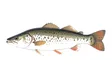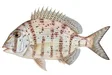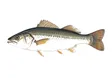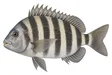
Taxonomy and naming
The Saucereye porgy was first described by the French zoologist, Achille Valenciennes in a 22- volume work entitled Histoire naturelle des poissons (Natural History of Fishes), which was a collaboration with fellow zoologist, Georges Cuvier. It was first described as Pagellus calamus, being placed in the genus Pagellus. It was since moved into Calamus, this name means "quill", in an allusion to what William Swainson described as "the second anal-fin spine, hollow, shaped as a pen" when he proposed the genus Calamus.
Description
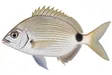
Saucereye porgies can grow up to 56 cm in length, but normally they are 30 to 45 cm long. Though some sources state that they can weigh up to 3 lbs, the largest record is only half that: 1.5 lbs. The cheek area is blue with yellow spots; there is also a dark blue smudge behind the upper gill opening.
Distribution and habitat
Saucereyes are found only in the western Atlantic Ocean —from North Carolina, east to Bermuda, and south to Brazil. They are most common around the cities of Key West and Havana. Adults are commonly found around coral reefs, where they are easily approached by divers, while juveniles are common to beds of sea grass (mainly Thalassia). Saucereyes feed on a variety of animals, such as mollusks, sea worms, brittle stars, hermit crabs, crabs and sea urchins.
Relationship with humans
The Saurcereye porgy is mostly eaten by people in the West Indies, where it is most often caught. These fishes are also considered to be of minor commercial importance to the region, despite the occasional danger of ciguatera poisoning during red tide events. They are usually marketed fresh or frozen.
Additional field notes
Saucereye porgy combines a deep, silvery body with a large eye and a steep forehead. Its name is especially useful when paired with Calamus calamus, because several porgies look similar from a distance.
Sources: Calamus calamus species account
Field identification notes
A curved blue line below the eye and yellowish markings on the forehead and cheek are helpful clues. The pectoral fin is long, reaching beyond the origin of the anal fin. The mouth is small, while the jaws carry front teeth and rounded crushing teeth along their sides.
Sources: Calamus calamus species account
Habitat and range notes
Adults occur around coral habitat and neighboring sand areas. Juveniles use seagrass, so young and adult fish need not be encountered in the same setting. The Smithsonian gives a regional range from North Carolina to Brazil and records depths from one to 84 meters.
Sources: Calamus calamus species account
Feeding and life-history notes
The diet categories include crustaceans, mollusks, worms, and echinoderms such as sea urchins. These are bottom-associated foods, consistent with a porgy’s crushing dentition. The source gives a maximum size of 56 cm; field identification still depends on the head, mouth, fins, and markings together.
Sources: Calamus calamus species account
Guide sources
Research reviewed 2026-10-17.
- Calamus calamus species account — Smithsonian Tropical Research Institute
Article text: Wikipedia contributors, Saucereye porgy (source revision). Licensed under CC BY-SA 4.0. Retrieved 2026-10-11.