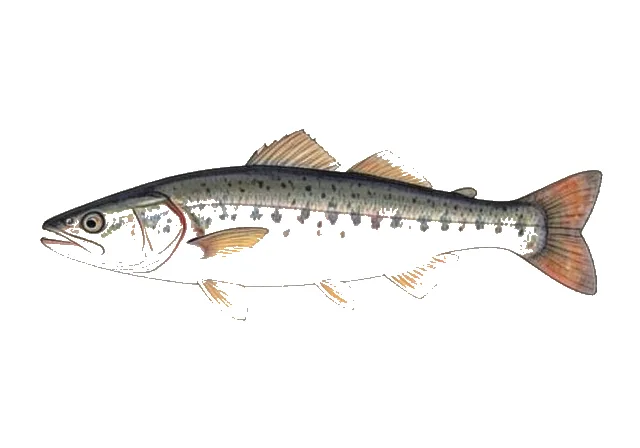
North Pacific Daggertooth

Anotopterus nikparini

Paralepididae · saltwater water fish

1 minute read · Species guide

North Pacific Daggertooth field guide illustration

About North Pacific Daggertooth

The North Pacific Daggertooth, Anotopterus nikparini is a species of fish in the family Anotopteridae, the daggertooths. It is native to the northern Pacific Ocean, where it occurs as far north as the Bering Sea and as far south as Japan and Baja California.

Etymology

The fish is named in honor of ichthyologist Nikolai Vasil’evich Parin (1932–2012), of the Russian Academy of Sciences.

Distribution

This fish can be found near the surface to depths below 2000 meters. Populations in colder regions are mainly larger, older adults.

Food chain

This species feeds on molluscs, crustaceans, marine worms, salps, and fish. It is an important predator of Pacific salmon. In turn, it is a prey item for whales and large fish such as albacore, lancetfish, halibut, steelhead, pomfret, and blue shark.

Article text: Wikipedia contributors, Anotopterus nikparini (source revision). Licensed under CC BY-SA 4.0. Retrieved 2026-10-11.
Range

Where it lives

Share of 5 GBIF observation records with a state location, across 2 states.
0%
60%
Share of 5 GBIF observation records with a state location, across 2 states.

Share of records by state

Habitat

Water and movement

Water
WoRMS records this species in the sea.

Classification

Taxonomy

Kingdom
Animalia
Phylum
Chordata
Superclass
Actinopterygii
Class
Teleostei
Order
Aulopiformes
Genus
Anotopterus
Species
Anotopterus nikparini
ITIS TSN
644719
WoRMS AphiaID
272040
GBIF key
2401112

Common questions about North Pacific Daggertooth

What is the scientific name of North Pacific Daggertooth?
The scientific name is Anotopterus nikparini, in the family Paralepididae. Classification follows ITIS.
Does North Pacific Daggertooth live in fresh water or salt water?
WoRMS records this species in the sea.
Where has North Pacific Daggertooth been recorded in the United States?
GBIF has observations in 2 states, with the most records in California, Alaska. The map shows observation records, which do not establish the complete natural range.

Same family

More Paralepididae