Distribution
There are two subspecies of Oligoplites saurus. The nominate subspecies O.s. saurus distributed in the western Atlantic Ocean from Chatham, Massachusetts south along the U.S. coast, throughout the Gulf of Mexico and Caribbean Sea, and along the South American coast to Rio Grande do Sul, Brazil. The other subspecies O. s. inornatus is found in the eastern Pacific Ocean from southern Baja California, much of the Gulf of California to Ecuador, including the Galapagos and Malpelo Islands.
Feeding
It voraciously devours small fish and shrimp, often in company with larger predatory species. Leatherjackets feed on small fish including the silver perch.
As food
Traditionally, the leather jacket has not been eaten, but recently, with large-scale farming of the fish, it has become common at market. The fish has a mild, oily taste similar to Spanish mackerel or bluefish.
It has occasionally been the prey to blue swimmer crab, as juvenile fish in sea grass beds.
Additional field notes
Leatherjack is an elongated coastal jack, also called leatherjacket. The Smithsonian regional account treats Atlantic fish as Oligoplites saurus saurus; this catalog keeps the broader species name Oligoplites saurus.
Sources: Oligoplites saurus species account
Field identification notes
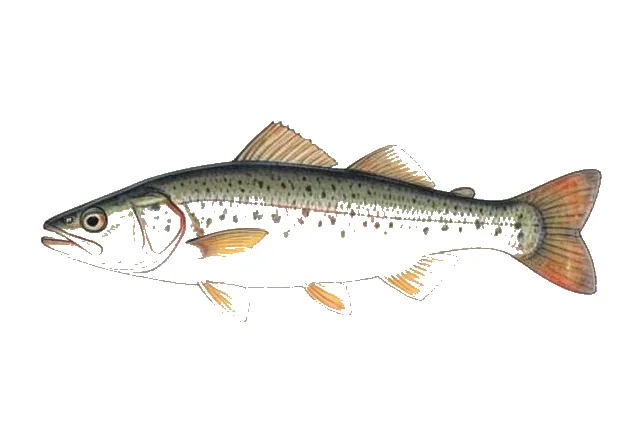
The body is strongly compressed, the snout pointed, and the tail deeply forked. The rear portions of the dorsal and anal fins form a series of partly detached finlets. The sides are silver, often with a greenish or bluish back and an amber tint to the tail.
Sources: Oligoplites saurus species account
Habitat and range notes
Schools occur along sandy beaches and in bays and estuaries. The account also records entry into fresh water. Its Atlantic range extends from Massachusetts to Brazil, while the eastern Pacific population is treated separately at subspecies rank.
Sources: Oligoplites saurus species account
Feeding and life-history notes
The source records animal plankton, small fishes, crustaceans, and ectoparasites among its food categories. It also specifically identifies the anal spines as venomous, an important distinction from an ordinary soft fin. Common size is listed around 25 cm, with a reported maximum of 35 cm in this regional account.
Sources: Oligoplites saurus species account
Guide sources
Research reviewed 2026-10-17.
- Oligoplites saurus species account — Smithsonian Tropical Research Institute
Article text: Wikipedia contributors, Leatherjacket fish (source revision). Licensed under CC BY-SA 4.0. Retrieved 2026-10-11.