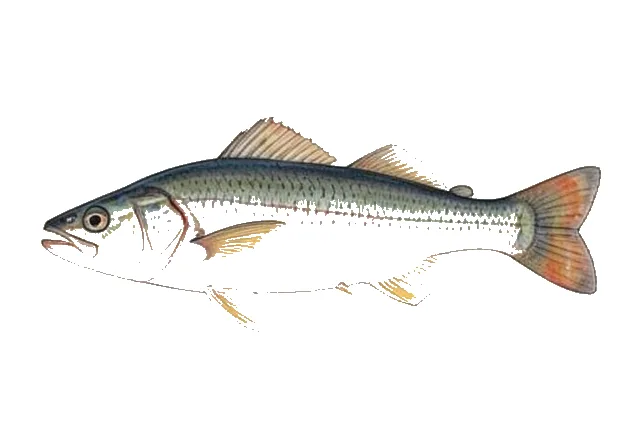
Fitch's Scabbardfish

Lepidopus fitchi

Trichiuridae · saltwater water fish

1 minute read · Species guide

Fitch's Scabbardfish field guide illustration

About Fitch's Scabbardfish

Fitch’s scabbardfish is an elongated, strongly flattened eastern Pacific fish. It occurs from Oregon to the Gulf of California and again farther south toward Peru. Schools generally occupy waters above sandy shelf and slope bottoms.

Identification

The body is black or brown with a silvery sheen along the belly. A very long dorsal fin carries roughly 78–87 rays. The pelvic fins are reduced to a small, scale-like spine and one or two tiny rays, rather than forming conspicuous paddles.

Sources: Lepidopus fitchi species summary

Depth and food

Most cited records are from 100–250 m, with a wider reported range to 500 m. During colder periods it may appear near the surface at night, and occasional mass strandings have been recorded. It feeds on cephalopods, krill-like crustaceans and small fishes, including northern anchovy and young Pacific hake.

Sources: Lepidopus fitchi species summary

Guide sources

Research reviewed 2026-10-19.

Range

Where it lives

Share of 60 GBIF observation records with a state location, across 2 states.
0%
95%
Share of 60 GBIF observation records with a state location, across 2 states.

Share of records by state

Habitat

Water and movement

Water
WoRMS records this species in the sea.

Classification

Taxonomy

Kingdom
Animalia
Phylum
Chordata
Superclass
Actinopterygii
Class
Teleostei
Order
Perciformes
Genus
Lepidopus
Species
Lepidopus fitchi
ITIS TSN
172393
WoRMS AphiaID
274018
GBIF key
5210263
Outside the US
ITIS also files it in Mexico.

Common questions about Fitch's Scabbardfish

What is the scientific name of Fitch's Scabbardfish?
The scientific name is Lepidopus fitchi, in the family Trichiuridae. Classification follows ITIS.
Does Fitch's Scabbardfish live in fresh water or salt water?
WoRMS records this species in the sea.
Where has Fitch's Scabbardfish been recorded in the United States?
GBIF has observations in 2 states, with the most records in California, Oregon. The map shows observation records, which do not establish the complete natural range.