Bluefish

Pomatomus saltatrix

Pomatomidae · saltwater and brackish water fish

11 minute read · Species guide

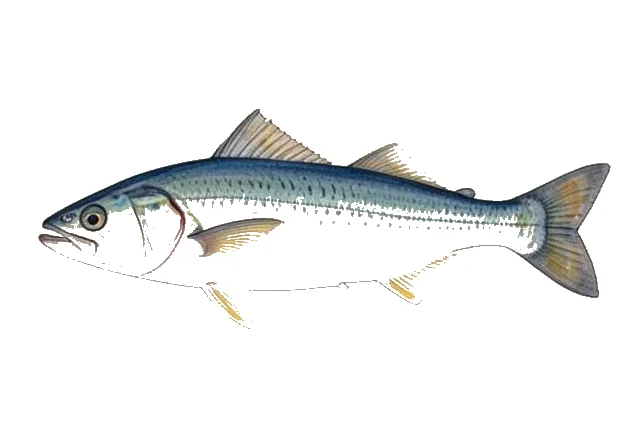
Bluefish field guide illustration

About Bluefish

The bluefish (Pomatomus saltatrix) is the only extant species of the family Pomatomidae. It is a marine pelagic fish found around the world in temperate and subtropical waters, except for the northern Pacific Ocean. Bluefish are known as tailor in Australia and New Zealand, elf and shad in South Africa. It is a popular gamefish and food fish.

The bluefish is a moderately proportioned fish, with a broad, forked tail. The spiny first dorsal fin is normally folded back in a groove, as are its pectoral fins. Coloration is a grayish blue-green dorsally, fading to white on the lower sides and belly. Its single row of teeth in each jaw is uniform in size, knife-edged, and sharp. Bluefish commonly range in size from "snappers" of 7 in (18 cm) to much larger, sometimes weighing as much as 30 lb (14 kg), though fish heavier than 20 lb (9 kg) are exceptional.

Taxonomy

The bluefish is the only extant species now included in the family Pomatomidae. At one time, gnomefishes were included, but these are now grouped in a separate family, Scombropidae. Extinct relatives of the bluefish include Carangopsis from the Early Eocene of Italy and Lophar from the Late Miocene of Southern California.

Distribution

Bluefish are widely distributed around the world in tropical and subtropical waters. They are found in pelagic waters on much of the continental shelves along eastern America (though not between south Florida and northern South America), Africa, the Mediterranean and Black Seas (and during migration in between), Southeast Asia, and Australia. They are found in a variety of coastal habitats: above the continental shelf, in energetic waters near surf beaches, or by rock headlands. They also enter estuaries and inhabit brackish waters. Periodically, they leave the coasts and migrate in schools through open waters.

Along the U.S. East Coast, bluefish are found off Florida in the winter. By April, they have disappeared, heading north. By June, they may be found off Massachusetts; in years of high abundance, stragglers may be found as far north as Nova Scotia. By October, they leave the waters north of Cape Cod, heading south down the East Coast of the United States from Rhode Island south to Georgia, to the waters off Florida. Some bluefish, perhaps less migratory, are present in the Gulf of Mexico throughout the year.

In a similar pattern overall, the economically significant population that spawns in Europe's Black Sea migrates south through Istanbul (Bosphorus, Sea of Marmara, Dardanelles, Aegean Sea) and on toward Turkey's Mediterranean coast in the autumn for the cold season. A campaign was launched in Turkey by Fikir Sahibi Damaklar (Intelligent Palates) to protect the Bluefish. This was reported on in 2013. More recently, it was reported that bluefish near Istanbul were abundant and that there is a fishing ban every year between April 15 - Sept. 1 to preserve fish eggs and ensure sustainable fish farming. Along the South African coast and environs, movement patterns are roughly in parallel.

Life history

Adult bluefish are typically 30–60 cm (12–24 in) long, with a maximum reported size of 130 cm (51 in) and 14 kg (31 lb). They reproduce during spring and summer, and can live up to 9 years. Bluefish fry eat zooplankton, and are largely at the mercy of currents. Spent bluefish have been found off east-central Florida, migrating north. As with most marine fish, their spawning habits are not well known. In the western side of the North Atlantic, at least two populations occur, separated by Cape Hatteras in North Carolina. The Gulf Stream can carry fry spawned to the south of Cape Hatteras to the north, and eddies can spin off, carrying them into populations found off the coast of the mid-Atlantic, and the New England states.

Feeding habits

Adult bluefish are strong and aggressive, and live in loose groups. They are fast swimmers that prey on schools of forage fish, and continue attacking them in feeding frenzies even after they appear to have eaten their fill. Depending on area and season, they favor menhaden and other sardine -like fish (Clupeidae), jacks (Scombridae), weakfish (Sciaenidae), grunts (Haemulidae), striped anchovies (Engraulidae), shrimp, and squid. They are cannibalistic and can destroy their own young. Bluefish sometimes chase bait through the surf zone, attacking schools in very shallow water, churning the water like a washing machine. This behavior is sometimes referred to as a "bluefish blitz".

In turn, bluefish are preyed upon by larger predators at all stages of their lifecycle. As juveniles, they fall victim to a wide variety of oceanic predators, including striped bass, larger bluefish, fluke (summer flounder), weakfish, tuna, sharks, rays, and dolphins. As adults, bluefish are taken by tuna, sharks, billfish, seals, sea lions, dolphins, porpoises, and many other species.

Bluefish are aggressive and have been known to inflict severe bites on fishermen. Wading or swimming among feeding bluefish schools can be dangerous. In July 2006, a seven-year-old girl was attacked on a beach, near the Spanish town of Alicante, allegedly by a bluefish. In New Jersey, the large beachfeeder schools are very common and lifeguards report never having seen bluefish bite bathers in their entire careers.

Parasites

Like other fish, bluefish host a number of parasites. One parasite is Philometra saltatrix, a philometrid nematode in the ovaries. The females are brownish red and may be as long as 80 mm; the males are very small.

Recreational fisheries

In Australia, bluefish, called "tailor", are caught on the east coast from Fraser Island in Queensland around the Australian coastline to Point Quobba in Western Australia, including Tasmania. Lower numbers are generally found around southern Australia. Tailor are pelagic, forming schools near the surface, and move inshore to feed in bays, estuaries, and surf zones at depths up to 15 m. The juveniles inhabit large bays and estuaries, while adults prefer the rocky headlands and beaches. Globally, the species occurs in tropical and temperate waters of the Atlantic, Pacific, and Indian Oceans, but is absent from the Eastern and Northwestern Pacific.

The IGFA All Tackle World Record for bluefish stands at 14.4 kg (31 lb 12 oz) landed by James Hussey near Hatteras, North Carolina. The unofficial record belongs to Captain Benjamin Dellacono who landed a 35 lb 6oz Blue Fish off the coast of Stonington, Connecticut.

Commercial fisheries

In the U.S., bluefish are landed primarily in recreational fisheries, but important commercial fisheries also exist in temperate and subtropical waters. Bluefish population abundance is typically cyclical, with abundance varying widely over a span of 10 years or more.

Management

Bluefish is a popular sport and food fish, and has been widely overfished. Fisheries management has generally stabilized its population. In the middle Atlantic region of the U.S., bluefish were heavily overfished in the late 1990s, but active management rebuilt the stock by 2007. Elsewhere, public awareness efforts, such as bluefish festivals, combined with catch limits, may be having positive effects in reducing the stress on the regional stocks.

Culinary use

Bluefish may be baked or smoked. The smaller ones ("snapper blues") are generally fried, as they are not very oily.

Because of its fattiness, bluefish goes rancid rapidly, so it is generally not found far from its fisheries, but where it is available, it is often inexpensive. It must be refrigerated and consumed soon after purchase; some recipes call for keeping it in vinegar and wine before cooking, in vina d'alhos or en escabeche.

Nutrition

By the same token, it is high in omega-3 fatty acids, but also in mercury and PCBs, containing the high level of about 0.4 ppm of mercury on average, comparable to albacore tuna or Spanish mackerel. For that reason, the U.S. FDA recommends that young children and women of childbearing age consume no more than one serving per week (a serving size is about 4 ounces [110 g] uncooked for an adult, 2 oz [55 g] for children ages 4–7 years, 3 oz [85 g] for children ages 8–10 years, and 4 ounces for children 11 years and older).

Article text: Wikipedia contributors, Bluefish (source revision). Licensed under CC BY-SA 4.0. Retrieved 2026-10-11.

NOAA Fisheries

Life history and status

NOAA management region
New England/Mid-Atlantic, Southeast

About the species

The Atlantic bluefish fishery in the U.S. operates from Maine to Florida. Bluefish are highly migratory along the U.S. Atlantic coast and seasonally move. The bluefish fishery predominantly uses gillnets, but other gear includes hook and line, pound nets, seines, and trawls. The recreational fishery accounts for the majority of the bluefish total catch each year. The market for bluefish is for human consumption and is primarily sold fresh or smoked. U.S. wild-caught bluefish is a smart seafood choice because it is sustainably managed and responsibly harvested under U.S. regulations. Implementing regulations are found at 50 CFR part 648 subpart J.

Population status

The bluefish stock is not overfished - rebuilding, and not subject to overfishing (supported by 2025 stock assessment). Summary stock assessment information can be found on Stock SMART .

Appearance

  • Bluefish are blue-green on the back and silvery on the sides and belly.
  • They have a prominent jaw, with sharp, compressed teeth.

Biology

  • Bluefish live up to 12 years.
  • They grow fast, up to 31 pounds and 39 inches.
  • They are able to reproduce at age 2, when they’re 15 to 20 inches in length.
  • Depending on their size, females can have between 400,000 and 2 million eggs.
  • Bluefish spawn multiple times in spring and summer.
  • They exhibit feeding behavior called the “bluefish blitz,” where large schools of big fish attack bait fish near the surface, churning the water like a washing machine. They feed voraciously on their prey, eating almost anything they can catch and swallow.
  • Bluefish have razor-sharp teeth and shearing jaws that allow them to ingest large parts, increasing the maximum size of the prey they can eat.
  • They eat squid and fish, particularly menhaden and smaller fish such as silversides.
  • Sharks, tunas, and billfishes are typically the only fish predators large and fast enough to prey on adult bluefish.
  • Bluefish make up a major part of the diet of shortfin mako sharks and are also very important in the diets of swordfish .
  • Oceanic birds prey on juvenile bluefish.

Where they live

  • Bluefish live in temperate and tropical coastal oceans around the world, except in the eastern Pacific.
  • They gather by size in schools that can cover tens of square miles of ocean, equivalent to 10,000 football fields.
  • Bluefish migrate seasonally, moving north in spring and summer as water temperatures rise and then south in autumn and winter to waters in the South Atlantic Bight.
  • Females release their eggs in the open ocean.
  • Larvae develop into juveniles near the surface in continental shelf waters and eventually move to estuarine and nearshore shelf habitats.
  • Juveniles prefer sandy ocean bottoms but will also inhabit mud, silt, or clay ocean bottoms or vegetated areas.
  • Adults live in both inshore and offshore areas and favor warmer water.
  • Along the East Coast from Maine to eastern Florida.

Fishery management

NOAA Fisheries, the Mid-Atlantic Fishery Management Council , and the Atlantic States Marine Fisheries Commission manage the bluefish fishery.

Managed under the Bluefish Fishery Management Plan : Commercial fishermen must have a permit to catch and sell bluefish. Managers set an annual catch limit. The majority of catch is allocated to the recreational fisheries. The commercial catch limit is divided into state-specific allocations. Unused recreational catch can be re-allocated to commercial fisheries. A rebuilding plan to rebuild the stock to the target population level is in place with a target date of 2029.

Fishing regulations

Possession and Size Requirements

The federal possession limit (bag limit) in the recreational bluefish fishery is dependent on the type of trip/vessel:

Private recreational vessels - 5 fish per person, per day

For-Hire Vessels (Party/Charter-Permitted Vessels) - 7 fish per person, per day

There is no federal size limit requirement. Please also check with your local state agency for any state or regional measures and requirements that may also apply.

2026 Atlantic Bluefish Recreational Specifications (January 1-December 31, 2026)

Commercial gear

There are no federal gear requirements in the commercial bluefish fishery. Please check with your state agency for any state or regional measures and requirements that may apply.

Management

Atlantic Bluefish is managed in state and federal waters by the Mid-Atlantic Fishery Management Council, in conjunction with the Atlantic States Marine Fisheries Commission. NOAA Fisheries serves as the implementing body for rules and regulations within the fishery.

The bluefish fishery is managed using a bag limit for the recreational fishery and an annual quota allocated to the states for the commercial fishery.

The fishing year runs from January 1 through December 31, and there are no specified management areas for the fishery; with NOAA Fisheries jurisdiction covering bluefish from Maine to Florida.

Control Dates for the Bluefish Fishery: Commercial - May 29, 1997; Recreational Charter/Party - February 11, 2025.

Science

NOAA Fisheries conducts various research activities on the biology, behavior, and population health of bluefish. The results of this research are used to inform management decisions for this species.

For detailed information about stock status, management, assessments, and resource trends, you can search for bluefish, and any other species of interest, using NOAA’s StockSMART web tool .

Addressing Bluefish Data and Research Needs

The bluefish management plan allows managers to set aside a small percentage of the annual catch limit for research. Proceeds from the sale of this set-aside catch are used to fund research on the fishery.

In 2012, managers established a coast-wide sampling program designed to improve the quantity and quality of information used in bluefish stock assessments. The program resulted in a significant increase in the amount of age-length keys and catch-at-age data that was used in future benchmark assessments.

Several key scientific gaps still need to be addressed to better inform bluefish management. For example, more research is needed on how much bluefish is caught and discarded in the commercial fisheries for bluefish and other species, the resulting impacts, and general population trends. There is also uncertainty in the methods used by scientists to monitor bluefish abundance and in estimating recreational catch along the Atlantic coast.

Range

Where it lives

Share of 5,308 GBIF observation records with a state location, across 19 states.
0%
60%
Share of 5,308 GBIF observation records with a state location, across 19 states.

Habitat

Water and movement

Water
WoRMS records this species in brackish water and the sea.

Classification

Taxonomy

Kingdom
Animalia
Phylum
Chordata
Superclass
Actinopterygii
Class
Teleostei
Order
Perciformes
Genus
Pomatomus
Species
Pomatomus saltatrix
ITIS TSN
168559
WoRMS AphiaID
151482
GBIF key
5208090

Common questions about Bluefish

What is the scientific name of Bluefish?
The scientific name is Pomatomus saltatrix, in the family Pomatomidae. Classification follows ITIS.
Does Bluefish live in fresh water or salt water?
WoRMS records this species in brackish water and the sea.
Where has Bluefish been recorded in the United States?
GBIF has observations in 19 states, with the most records in Texas, Florida, North Carolina. The map shows observation records, which do not establish the complete natural range.