Atlantic Sharpnose Shark

Rhizoprionodon terraenovae

Carcharhinidae · saltwater and brackish water fish

7 minute read · Species guide

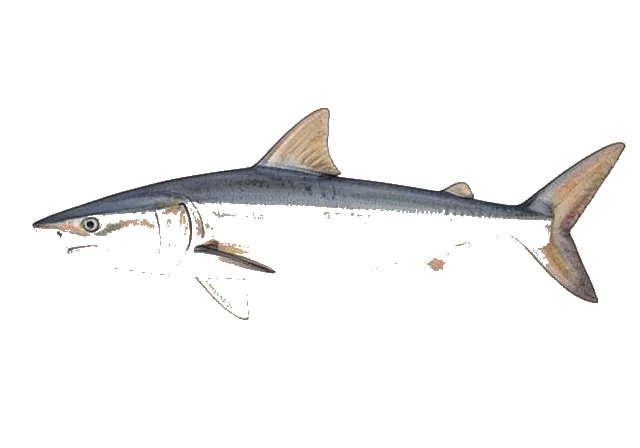
Atlantic Sharpnose Shark field guide illustration

About Atlantic Sharpnose Shark

The Atlantic sharpnose shark (Rhizoprionodon terraenovae) is a species of requiem shark in the family Carcharhinidae. It is found in the subtropical waters of the north-western Atlantic Ocean, between latitudes 43°N and 18°N.

Description

The Atlantic sharpnose shark is a small shark in comparison to others. The Atlantic sharpnose shark's maximum species length is known to be about 110–120 cm (3.6–3.9 ft). Although its average adult size tends to be about 91.4–99 cm (3.00–3.25 ft). Reports exist of these sharks living up to 19 years in the wild. A distinctive feature is that juveniles have black edges on the dorsal and caudal fins.

Habitat

Atlantic sharpnose sharks can be found as far north as New Brunswick, Canada, to as far south as the southern Gulf of Mexico. Reports of specimens from Brazil are likely being confused with the Brazilian sharpnose shark. Atlantic sharpnose sharks prefer to live in warmer, shallow coastal waters. As they are often found in waters less than 10.1 m (33 ft) deep. Although Atlantic sharpnose reportedly were found at 280 m (920 ft) deep.

Feeding habits

The diet of the Atlantic sharpnose sharks mostly consists of bony fish, worms, shrimp, crabs, and mollusks. Commonly consumed fish include menhaden, eels, silversides, wrasses, jacks, toadfish, and filefish.

Maturation

Atlantic sharpnose sharks are born ranging from a length of 29–37 cm (11–15 in). For the first three months after birth, they grow an average of 5 cm (2.0 in) per month. Then, in the winter and spring, the average growth rate decreases to 0.9 cm (0.35 in) per month until the shark reaches a length of 60 to 65 cm (24 to 26 in), in which the shark's growth rate increases linearly about 1.3 cm (0.51 in) per month for about a year. Males mature at the age of 2–3 years at a length of 80–85 cm (31–33 in), while females seem to mature at the age of 2.5–3.5 years old, at a length around 84–89 cm (33–35 in).

Reproduction

Female Atlantic sharpnose sharks are viviparous, and tend to have a litter of four to six pups, but litter size may range from one to seven pups, after a gestation period of 10–11 months. The pups are usually born at between 29 and 37 cm (11 and 15 in) in total length. Females are found in the marine estuaries during the late spring, but they breed mostly throughout the year.

Captivity

Generally, Atlantic sharpnose sharks are better suited for public aquaria, or very experienced private shark aquarists who are capable of caring for them. These sharks are highly active swimmers and require ample space. Also, these sharks tend to do best in small schools of at least three sharks. Tanks or ponds which are round or oval-shaped are best suited for these sharks. They have been reported to live at least 4 years in captivity.

Article text: Wikipedia contributors, Atlantic sharpnose shark (source revision). Licensed under CC BY-SA 4.0. Retrieved 2026-10-11.
NOAA Fisheries

Life history and status

Length
Up to 4 feet
NOAA management region
New England/Mid-Atlantic, Southeast

About the species

U.S. wild-caught Atlantic sharpnose shark is a smart seafood choice because it is sustainably managed and responsibly harvested under U.S. regulations.

Population status

There are two stocks of Atlantic sharpnose shark: Atlantic and Gulf of America* (formerly Gulf of Mexico). According to the most recent stock assessments: The Atlantic stock is not overfished and not subject to overfishing (2013). Summary stock assessment information can be found on Stock SMART . The Gulf of America stock is not overfished and not subject to overfishing (2013). Summary stock assessment information can be found on Stock SMART .

Appearance

  • Atlantic sharpnose sharks are small for sharks and have a streamlined body.
  • They get their name from their long, pointy snout.
  • They are several different shades of gray and have a white underside.
  • Adults have white spots on their sides and white along the edges of their pectoral fins.
  • Young sharks have black on their dorsal (back) and caudal (tail) fin edges.
  • The lower and upper jaws of an Atlantic sharpnose shark have 24 or 25 rows of triangular teeth.

Biology

  • Atlantic sharpnose sharks can grow to up to 32 inches in length.
  • They grow and mature at different rates in the Atlantic and Gulf of America.
  • Females mature at around 2 years old in the Atlantic when they reach approximately 24 inches in length, and at around 1.3 years old in the Gulf of America when they are approximately 25 inches in length.
  • Atlantic sharpnose sharks have been observed to live up to 18 years.
  • In both the Atlantic and Gulf of America, Atlantic sharpnose sharks mate annually between mid-May and mid-July in inshore waters.
  • After mating they migrate offshore to deeper waters.
  • The mother feeds the pups through a placental sac and after a gestation period of 10 to 11 months the females return to nearshore areas to give birth in June.
  • Litters average approximately four pups in both the Gulf of America and Atlantic.
  • Atlantic sharpnose sharks eat small fish, including menhaden, eels, silversides, wrasses, jacks, toadfish, and filefish. They also eat worms, shrimp, crabs, and mollusks.
  • Large carnivorous fish, including large sharks, eat Atlantic sharpnose sharks.

Where they live

  • Atlantic sharpnose sharks live in both warm-temperate and tropical waters, from the Bay of Fundy to the Yucatan.
  • They can be found as deep as 920 feet, but mostly remain in waters less than 32 feet deep.
  • They are commonly found in bays, estuaries, harbors, and the surf zone (area where waves break, commonly at 16 to 32 feet deep), mostly over mud and sand bottoms.
  • Atlantic sharpnose sharks seasonally migrate between inshore and offshore waters, moving to deeper offshore waters in winter and returning to inshore waters in spring to mate and give birth.
  • During migrations, they form large schools separated by sex.
  • Atlantic sharpnose sharks are commonly found in the western Atlantic from New Brunswick, Canada through the Gulf of America and are commonly caught in U.S. waters from Virginia to Texas.

Fishery management

NOAA Fisheries and the Atlantic Highly Migratory Species Division manage the Atlantic sharpnose shark fishery.

Managed under the Consolidated Highly Migratory Species Fishery Management Plan : Permits are required, and only a limited number of permits are available. Commercial quotas and limits on how many sharks can be landed per fishing trip. Gear restrictions and requirements. Fishing season is generally year-round, but the sharpnose shark fishery, managed as part of the non-blacknose small coastal shark management group, may close when the landings are projected to reach 80 percent of the quota. Shark dealers are required to attend Atlantic shark identification workshops to help them better identify shark species. There are more than 20 species of sharks that cannot be landed (e.g., white, dusky, basking, longfin mako, night) and some of these species look similar to the species that can be landed. The recreational shark identification can help with identification. The Shark Conservation Act requires that Atlantic sharpnose sharks be brought to shore with their fins naturally attached. Compliance guides are available for all commercial and recreational regulations across Atlantic highly migratory species fisheries.

There are no international management measures for Atlantic sharpnose sharks.

Science

NOAA Fisheries conducts various research activities on the biology, behavior, and population health of Atlantic sharpnose sharks. The results of this research are used to inform management decisions for this species.

For details information about stock status, management assessments, and resource trends, you can search for Atlantic sharpnose shark, and any other species of interest, using NOAA's StockSMART web tool .

Atlantic Sharpnose Shark Research

Scientists at the Southeast Fisheries Science Center assess the status of Atlantic sharpnose sharks through the Southeast Data, Assessment, and Review process. NOAA Fisheries also conducts shark research in the Northeast , studying life history and performing long-term monitoring activities for stock assessment and management.

Ongoing research priorities for Atlantic sharpnose sharks include enhancing life history information, identifying additional bycatch minimization strategies, and improving the identification of essential fish habitat.

Collaborating Across Fisheries Sectors

Scientists have made great strides collecting data on Atlantic sharpnose shark catch in other fisheries. For instance, records for sharks caught in shrimp trawls are now more detailed and include species-level information, which helps managers effectively understand and minimize bycatch of sharpnose sharks in the trawl fisheries.

Range

Where it lives

Share of 1,875 GBIF observation records with a state location, across 12 states.
0%
49.2%
Share of 1,875 GBIF observation records with a state location, across 12 states.

Habitat

Water and movement

Water
WoRMS records this species in brackish water and the sea.
USGS NAS habitat
Marine
US status
Native transplant — native to part of the United States, moved to other waters inside it.

Classification

Taxonomy

Kingdom
Animalia
Phylum
Chordata
Superclass
Chondrichthyes
Class
Chondrichthyes
Order
Carcharhiniformes
Genus
Rhizoprionodon
Species
Rhizoprionodon terraenovae
ITIS TSN
160200
WoRMS AphiaID
158510
GBIF key
2417892

Common questions about Atlantic Sharpnose Shark

What is the scientific name of Atlantic Sharpnose Shark?
The scientific name is Rhizoprionodon terraenovae, in the family Carcharhinidae. Classification follows ITIS.
Does Atlantic Sharpnose Shark live in fresh water or salt water?
WoRMS records this species in brackish water and the sea.
Where has Atlantic Sharpnose Shark been recorded in the United States?
GBIF has observations in 12 states, with the most records in Florida, North Carolina, Texas. The map shows observation records, which do not establish the complete natural range.
How big does Atlantic Sharpnose Shark get?
NOAA Fisheries lists its length as Up to 4 feet.

Same family

More Carcharhinidae