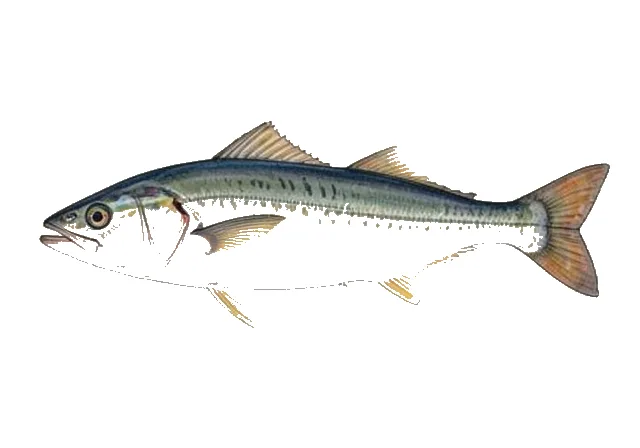
American Sackfish

Neoepinnula americana

Gempylidae · saltwater water fish

1 minute read · Species guide

American Sackfish field guide illustration

About American Sackfish

American sackfish is a deep-water western Atlantic fish, recorded from the Gulf of Mexico, Yucatán Channel, Caribbean waters off Venezuela, and parts of the South American coast. FishBase places it near the bottom and in the water above it at reported depths of 184–457 m.

Identification

The body is silver-sided with a brown back. Two lateral lines run along each side, beginning near the upper corner of the gill opening; the lower line may branch from the upper one. The first dorsal fin is dark, and the front of the second dorsal fin is also black. Counts of fin spines and rays are useful when separating it from related deep-water fishes.

Sources: Neoepinnula americana species summary

Distribution records

Its known localities include scattered deep-water records off Suriname and southern Brazil. These establish a broad western Atlantic occurrence but do not demonstrate equal abundance throughout that range.

Sources: Neoepinnula americana species summary

Guide sources

Research reviewed 2026-10-19.

Range

Where it lives

Share of 16 GBIF observation records with a state location, across 6 states.
0%
31.3%
Share of 16 GBIF observation records with a state location, across 6 states.

Habitat

Water and movement

Water
WoRMS records this species in the sea.

Classification

Taxonomy

Kingdom
Animalia
Phylum
Chordata
Superclass
Actinopterygii
Class
Teleostei
Order
Perciformes
Genus
Neoepinnula
Species
Neoepinnula americana
ITIS TSN
550874
WoRMS AphiaID
159712
GBIF key
2397763

Common questions about American Sackfish

What is the scientific name of American Sackfish?
The scientific name is Neoepinnula americana, in the family Gempylidae. Classification follows ITIS.
Does American Sackfish live in fresh water or salt water?
WoRMS records this species in the sea.
Where has American Sackfish been recorded in the United States?
GBIF has observations in 6 states, with the most records in Florida, Alabama, Louisiana. The map shows observation records, which do not establish the complete natural range.